
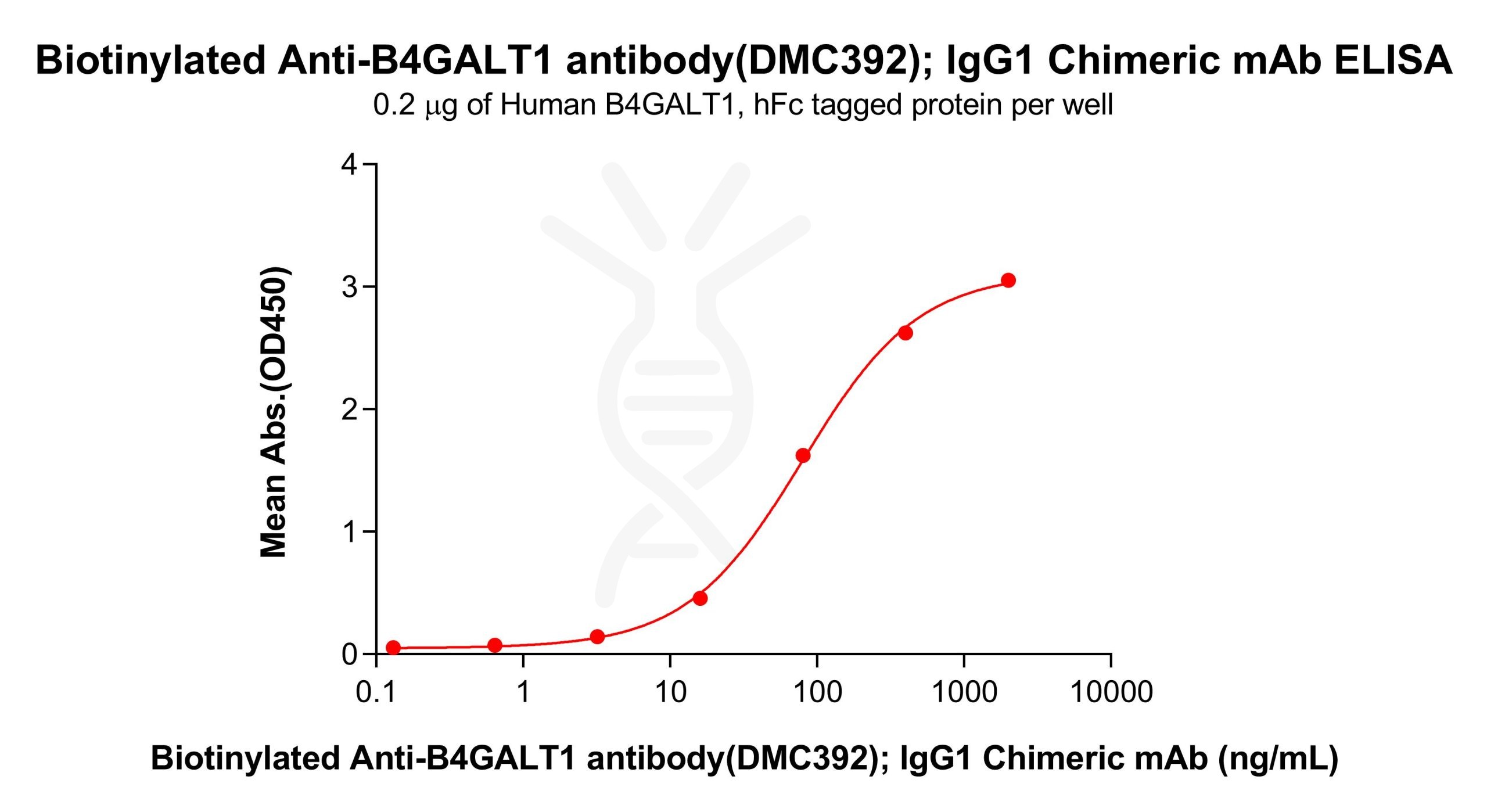
| Clone ID | DMC392 |
|---|---|
| Target | |
| Synonyms | GGTB2; Beta4Gal-T1; b4Gal-T1; Nal synthase |
| Host Species | Rabbit |
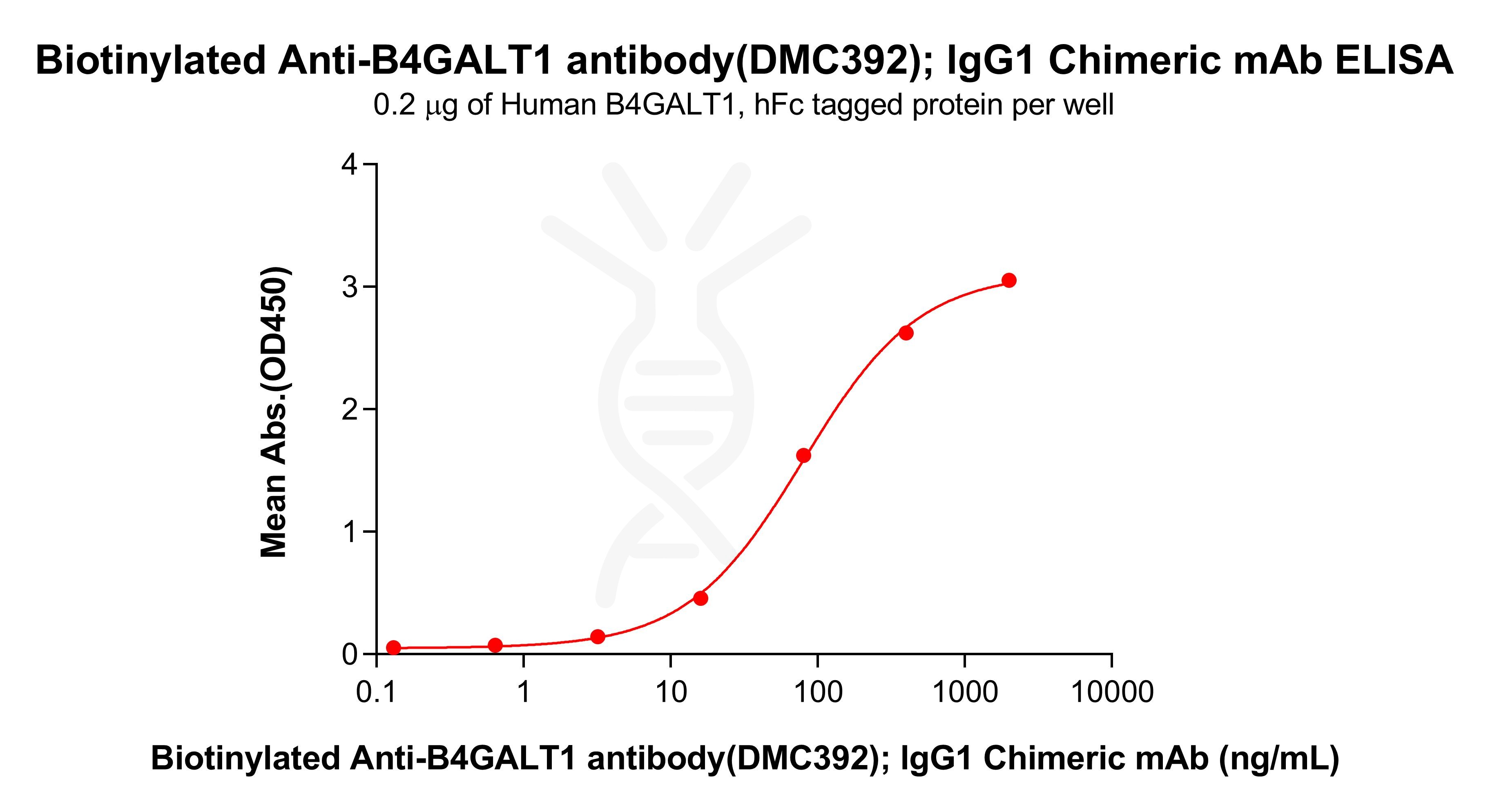
| Description | Biotinylated Anti-B4GALT1 antibody(DMC392); IgG1 Chimeric mAb |
| Delivery | In Stock |
| Uniprot ID | P15291 |
| IgG type | Rabbit/Human Fc chimeric IgG1 |
| Clonality | Monoclonal |
| Reactivity | Human |
| Applications | ELISA |
| Recommended Dilutions | ELISA 1:5000-10000 |
| Purification | Purified from cell culture supernatant by affinity chromatography |
| Formulation & Reconstitution | Lyophilized from sterile PBS, pH 7.4. Normally 5 % – 8% trehalose is added as protectants before lyophilization. Please see Certificate of Analysis for specific instructions of reconstitution. |
| Storage & Shipping | Store at -20°C to -80°C for 12 months in lyophilized form. After reconstitution, if not intended for use within a month, aliquot and store at -80°C (Avoid repeated freezing and thawing). Lyophilized proteins are shipped at ambient temperature. |
| Background | This gene is one of seven beta-1,4-galactosyltransferase (beta4GalT) genes. They encode type II membrane-bound glycoproteins that appear to have exclusive specificity for the donor substrate UDP-galactose; all transfer galactose in a beta1,4 linkage to similar acceptor sugars: GlcNAc; Glc; and Xyl. Each beta4GalT has a distinct function in the biosynthesis of different glycoconjugates and saccharide structures. As type II membrane proteins; they have an N-terminal hydrophobic signal sequence that directs the protein to the Golgi apparatus and which then remains uncleaved to function as a transmembrane anchor. By sequence similarity; the beta4GalTs form four groups: beta4GalT1 and beta4GalT2; beta4GalT3 and beta4GalT4; beta4GalT5 and beta4GalT6; and beta4GalT7. This gene is unique among the beta4GalT genes because it encodes an enzyme that participates both in glycoconjugate and lactose biosynthesis. For the first activity; the enzyme adds galactose to N-acetylglucosamine residues that are either monosaccharides or the nonreducing ends of glycoprotein carbohydrate chains. The second activity is restricted to lactating mammary tissues where the enzyme forms a heterodimer with alpha-lactalbumin to catalyze UDP-galactose D-glucose UDP lactose. The two enzymatic forms result from alternate transcription initiation sites and post-translational processing. Two transcripts; which differ only at the 5' end; with approximate lengths of 4.1 kb and 3.9 kb encode the same protein. The longer transcript encodes the type II membrane-bound; trans-Golgi resident protein involved in glycoconjugate biosynthesis. The shorter transcript encodes a protein which is cleaved to form the soluble lactose synthase. |
| Usage | Research use only |
| Conjugate | Biotinylated |
| DIMA Disclaimer | All DIMA recombinant antibodies are genuinely generated by DIMA Biotech. They are all under patent application. Any protein sequencing or reverse engineering attempt is prohibited. We are actively scr |



服務(wù)熱線
400-006-0995
18062749453
